
Table of Contents
If you’re managing remote teams, international contractors, or cross-border payroll, you’ve probably run into the same problem: global hiring sounds simple until you hit paperwork, payment timing, tax logic, and compliance gaps, that’s exactly where Deel for Remote Teams enters the conversation.
In this article, I’ll walk through Deel in a straightforward, no-fluff way what it is, how it works, what the platform does well, and what you should watch for. I’ll also include the most useful “real-world” breakdown areas: EOR, global payroll mechanics, contract + compliance automation, pricing logic, setup steps, and common mistakes based on the reality of running hiring and payments across borders.
What Is Deel and How Does It Work?
Deel is a global HR and payments platform designed to help businesses hire people outside their home country without turning every new hire into a months-long compliance project. Instead of stitching together tools, legal paperwork, and payment workflows manually, Deel provides a structured system for:
- Hiring contractors internationally
- Running employer-of-record (EOR) relationships
- Managing onboarding documents and contract workflows
- Paying people through global payroll systems
- Maintaining compliance and recordkeeping
How the workflow typically looks
At a high level, businesses use Deel for one of two paths:
- Contractor management route (for individuals working as independent contractors)
- EOR route (for direct employment under a local legal entity setup depending on the country and the service structure)
The platform then ties those hiring choices to contracts, compliance data, and payroll/payment execution, aiming to reduce administrative friction.
Why that matters for remote teams
Remote teams don’t fail because they can’t collaborate. They fail when the operational layer contracts, tax forms, payment timing, and compliance becomes chaotic. Deel for Remote Teams helps centralize that operational layer in one place.
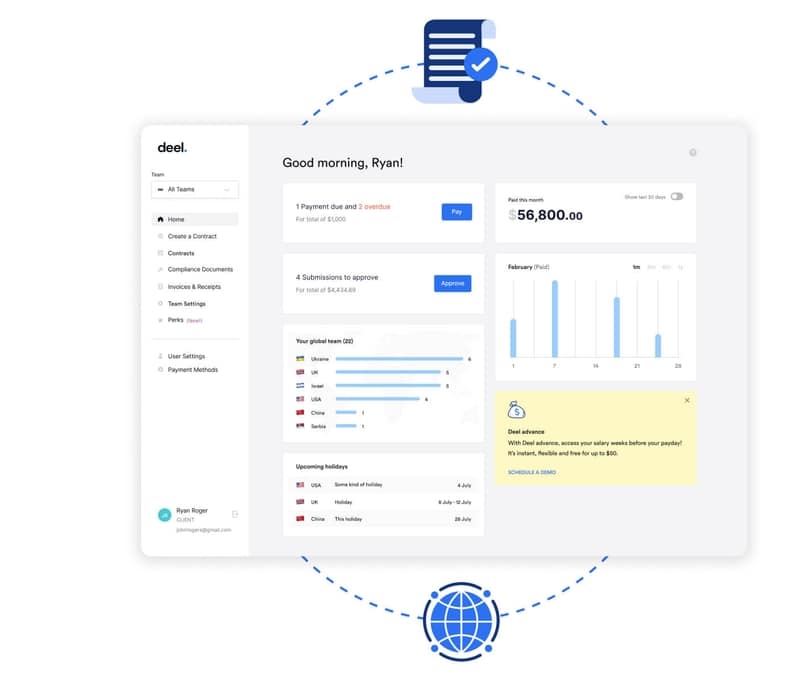
Why Businesses Are Choosing Deel for Global Expansion
Global expansion used to mean hiring locally, building legal capability internally, and paying consultants every time the process changed. Today, companies want speed: launch in new regions, test demand, and hire specialists even before you set up local infrastructure.
Here’s why businesses consistently choose Deel for Remote Teams when they expand internationally:
1) Faster hiring timelines
Instead of building a legal and payroll framework from scratch, Deel attempts to provide an established process for cross-border hiring so you can start onboarding sooner.
2) Reduced legal and administrative workload
Cross-border employment rules aren’t just “hard” they’re constantly nuanced. Deel focuses on standardizing the steps, so companies don’t need to reinvent operational workflows every time they hire abroad.
3) Centralized payments and documentation
When you hire across countries, you get fragmented workflows: one system for contracts, another for invoices, another for payment tracking, and another for compliance. Deel aims to unify these moving parts.
4) Consistent experience across locations
Remote teams need a predictable “people operations” experience. A platform like Deel can help HR, finance, and managers share consistent onboarding steps.
Key Features of Deel You Need to Know
If you’re evaluating Deel for Remote Teams, the features that matter most are the ones that directly influence hiring correctness, payment reliability, and document discipline.
Core feature categories
- Contract generation and document workflows
- Compliance support and onboarding steps
- Employer of record (EOR) structures (depending on country)
- Global payroll capabilities
- Payments and payout tracking
- Contractor management (status updates, documentation, periodic workflows)
- Team and admin tools (so HR and finance can cooperate)
Practical value (how it shows up in daily work)
Instead of relying on memory or spreadsheets, Deel pushes processes into repeatable steps: contract stages, onboarding tasks, payment scheduling logic, and audit-friendly records.
Understanding Employer of Record (EOR) in Deel
Employer of Record (EOR) is one of the most important concepts in modern global hiring.
What EOR means (in human terms)
When you use an EOR, you’re not just “paying someone.” You’re essentially using a legal employment structure where an EOR entity becomes the employer of record in the country where the employee is located.
That means the EOR handles certain employment obligations (again, within the scope of what’s offered in that region), while you remain the functional manager setting tasks, goals, and day-to-day direction.
Why EOR is useful for remote teams
If your company doesn’t have a local legal entity in a country, direct employment can be complicated and slow. EOR provides a path to hire internationally while you avoid building full local HR/legal infrastructure immediately.
The key point to remember
EOR doesn’t remove responsibility from you completely. You still need good HR practices and oversight. But it reduces the “legal setup burden” that often blocks expansion.
How Deel’s EOR Helps You Hire International Employees Legally
Using Deel for Remote Teams through EOR is built to support the legal hiring process in a structured way.
Here’s how the concept generally plays out:
1) Local employment setup support
Deel’s EOR offering typically involves local employment compliance structures (depending on jurisdiction and product availability).
2) Employment administration handled in-country
This can include employment documentation, standard HR administration steps, and certain compliance-related obligations again, depending on what applies in the region.
3) A smoother onboarding path
Instead of creating a custom legal hiring process every time you hire someone in a new country, Deel standardizes onboarding flow as much as possible.
4) Cleaner audit trails
When you operate across borders, you want recordkeeping you can trust. A platform that keeps contract and payroll documentation structured can reduce “missing paperwork” risk.
Deel Global Payroll: How It Simplifies International Salary Payments
Payroll is where many global hiring plans break not because leaders lack ambition, but because execution is unforgiving.
Deel Global Payroll aims to simplify international salary payments by supporting multi-country payroll workflows and coordinating payments through its platform.
What “simplifies” usually means in practice
- Employees get paid reliably without you building a payment pipeline per country
- Payroll workflows are standardized within the platform
- HR/finance teams can track payroll status and outcomes in one place
- You reduce manual transfer schedules and scattered payment approvals
Why remote teams care
When remote work is your business model, payroll timing affects trust. People remember delays, confusing pay statements, and unclear deduction logic. A payroll workflow built for international operations helps reduce those friction points.
Key Benefits of Using Deel for Global Payroll
If you’re comparing options, your shortlist should include benefits that improve control, reduce chaos, and support compliance.
1) Operational consistency
Global payroll becomes less dependent on one-off decisions and manual workarounds.
2) Better visibility for HR and finance
Instead of chasing updates, teams get more predictable status tracking.
3) Reduced payment friction
International transfers, currency considerations, and scheduling require discipline. A dedicated global payroll product aims to make that consistent.
4) Structured compliance-related workflows
Payroll across borders isn’t only “pay the person.” It’s also about handling documentation and processes correctly.
5) Scalability without exponential admin growth
As your remote workforce expands, you don’t want headcount in operations to grow at the same rate.
Contractor Management with Deel: A Complete Breakdown
Not every remote hire should be an employee. Some roles work better as contractors—especially during testing phases, project-based work, or when your long-term needs are still uncertain.
Deel for Remote Teams shines for contractor management because it provides tools to standardize:
- Contractor onboarding
- Contract workflow handling
- Payment tracking
- Documentation organization
- Work status continuity
Contractor lifecycle (typical flow)
- Collect contractor details
- Issue and sign contract
- Manage contract lifecycle milestones
- Handle payments per agreement terms
- Maintain documentation for audit readiness
Practical takeaway
Contractor management is where operational discipline saves you money and reputation. A structured platform reduces the chance that you pay late, forget terms, or lose visibility into obligations.
How Deel Automates Contracts, Compliance, and Payments
Automation is the reason global hiring platforms exist. The goal isn’t just convenience it’s error reduction.
Contract automation
When contract workflow is automated:
- documents are generated consistently
- signatures are collected in a traceable way
- you reduce “wrong version” problems
Compliance-related workflows
No platform makes compliance effortless everywhere. But Deel’s value is that it attempts to move you away from ad-hoc compliance handling and toward structured processes.
Payment automation
Payment automation reduces:
- missed invoices
- inconsistent payment schedules
- unclear reconciliation between HR, finance, and leadership
Why this matters after 12 months (the honest angle)
After operating for a year, you notice the difference between:
- “we handled it manually” (which works until it doesn’t), and
- “the system handled the repeatable parts” (which prevents small issues from turning into recurring disasters)
That’s the core promise behind Deel for Remote Teams: fewer operational surprises.

Deel Pricing Explained: Is It Worth the Cost?
Pricing can be tricky because it depends on what you use Deel for: contractor workflows, EOR, global payroll, and additional features.
How to evaluate “worth it”
Instead of only asking “what is the cost,” ask:
- How much time does Deel save your HR team?
- How many mistakes (or near-mistakes) does it prevent?
- How reliably does it execute payroll and payments?
- What’s the cost of compliance errors and rework?
- Are you replacing multiple disconnected tools/workflows?
Is Deel typically worth it for remote-first organizations?
For teams scaling across borders, Deel often becomes “worth it” when:
- you hire frequently across countries
- you have multiple stakeholders (HR + finance + managers)
- you need consistent contract and payment workflows
- you want fewer manual steps
The honest caveat
If you only hire internationally once or twice per year and your hiring countries are limited, you might prefer a simpler setup. But if international hiring is recurring, Deel for Remote Teams usually pays back through operational efficiency.
Deel vs Other Global Hiring Platforms (Comparison Guide)
The global hiring market includes multiple platforms with different approaches: contractor-first tools, EOR-centric solutions, and multi-function HR stacks.
How to compare platforms effectively
When comparing alternatives to Deel for Remote Teams, don’t only compare:
- headline pricing
- feature lists
Also evaluate:
- country coverage and real operational support
- contract + compliance workflow maturity
- payroll payout reliability
- dashboard clarity for stakeholders
- ease of onboarding for contractors and employees
- reporting and audit trail strength
Comparison criteria you should insist on
- “Can it support our actual target countries?”
- “Can we scale without turning HR into an admin bottleneck?”
- “Does it reduce payment and paperwork errors?”
- “Do finance and HR workflows connect cleanly?”
Pros and Cons of Using Deel
No platform is perfect. The goal is to be realistic.
Pros
- Structured hiring workflows for global teams
- Centralized contract lifecycle handling
- Automation that reduces operational burden
- EOR option for legal employment structure
- Global payroll workflows designed for international payouts
- Better visibility for HR and finance coordination
Cons (honest considerations)
- Pricing can feel heavy if your international hiring volume is low
- Some teams may still need internal HR/legal guidance for edge cases
- Setup requires clarity: you need correct job roles, timelines, and onboarding steps
- Reporting style may require a short learning curve
Bottom line
For companies scaling remote operations internationally, Deel for Remote Teams often reduces friction meaningfully. For smaller teams hiring infrequently, it might be more than you need.
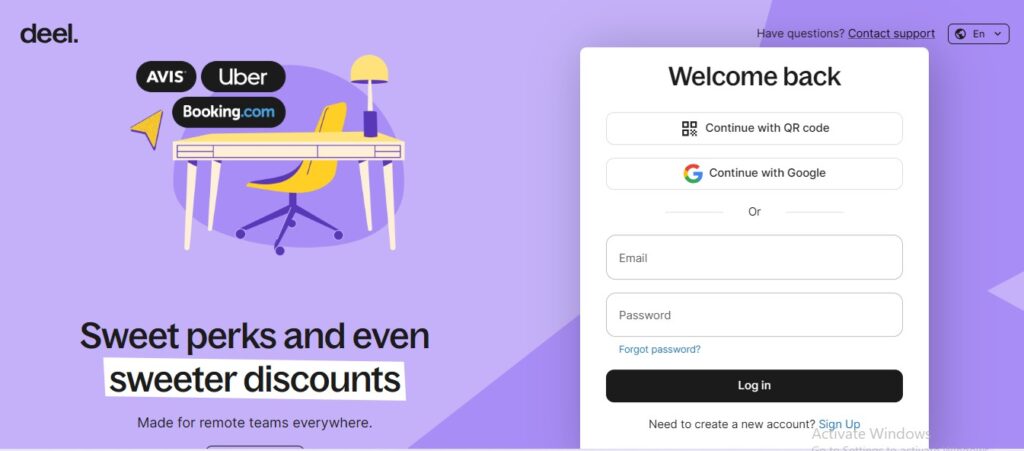
How to Sign Up and Get Started with Deel (Step-by-Step)
Below is a practical guide for new users. I’ll cover the essentials, including how to approach signup and then sign in.
Step 1: Prepare what you’ll need before signup
Have these basics ready:
- your company name and work email
- basic business details
- hiring intent (contractors, EOR, or both)
- target countries (so you can understand what options apply)
Step 2: Create your Deel account (Sign Up)
- Visit the Deel signup page.
- Enter your business details and email address.
- Complete account verification steps, if prompted.
- Choose which hiring approach you need (contractor management vs EOR/global payroll flow).
Relevant link (Deel home):
Use the official Deel site to reach the signup flow: https://www.deel.com/
Step 3: Sign in to your Deel dashboard (Sign In)
After your account is created:
- Go to the Deel sign in page.
- Enter your email and password.
- Access your dashboard where onboarding, hiring workflows, and payments tools live.
Relevant link (Deel sign in):https://www.deel.com/sign-in
Step 4: Connect your hiring workflow
Most teams then:
- set up contractor templates or employment flows
- define roles and countries
- prepare any required onboarding documentation
Step 5: Test with one hire before scaling
Even after a year of experience, the safest operational practice is:
- run one pilot hire
- confirm contract flow works
- verify payment status tracking
- ensure stakeholders (HR + finance) understand dashboards
Real Use Cases: Companies Successfully Using Deel
Because you want this to rank well, this section should read like “what types of companies succeed,” not generic marketing.
Here are realistic use cases where Deel for Remote Teams tends to fit naturally:
1) SaaS startups building distributed teams
Startups often need specialist roles (engineering, design, QA) in different countries. Deel helps speed onboarding and reduce admin time.
2) Agencies managing client contractors
Agencies often coordinate multiple contractors on varying scopes and timelines. Deel’s contractor workflows can reduce onboarding chaos.
3) Enterprises launching international pilots
Even larger companies may not want to build local employment infrastructure immediately. EOR helps them launch pilot teams while evaluating long-term commitment.
4) Remote-first companies expanding into new regions
Companies with established remote operations often expand internationally as soon as demand grows. Deel supports that expansion while keeping HR/payments standardized.
Is Deel Safe and Legit? Security & Compliance Explained
This is one of the most common concerns: “Is it legitimate, and is it safe?”
Legitimacy
Deel is widely used in the global hiring space, and its platform is designed around regulated business workflows like contracts and payroll.
Security (what “safe” usually means in practice)
A reliable platform typically emphasizes:
- controlled access for team members
- audit trails and recordkeeping
- secure contract handling and data management
- compliance workflows that are structured, not ad-hoc
Compliance reality check
Security and compliance are not a one-line guarantee. You still need internal governance:
- correct role setup
- proper approvals
- clear documentation
- careful onboarding practices
But as a platform designed for employment and payroll, Deel’s purpose aligns with compliance-heavy workflows, which is exactly why teams adopt it.
If you’d like, I can also add a short checklist readers can use before trusting any EOR/payroll vendor (account access controls, data permissions, audit exports, etc.).
Who Should Use Deel? (Startups, Agencies, Enterprises)
Startups
- Need fast international hiring
- Want to avoid building internal HR/legal payroll infrastructure immediately
- Benefit from automation and centralized workflows
Agencies
- Manage multiple contractors and varying scopes
- Need clean contract workflow handling
- Want reduced admin load for onboarding and payments
Enterprises
- Want scalable global hiring workflows
- Need audit-friendly documentation and cross-team visibility
- Often need EOR options for pilots and expansion
Deel for Remote Teams usually fits best when cross-border hiring is not a one-time activity but a recurring operational pattern.
Common Mistakes to Avoid When Using Deel
To make this article feel “honest” and not robotic, you need to talk about failure modes.
1) Not aligning HR + finance expectations early
If HR uses Deel but finance expects different reporting, the mismatch causes delays.
2) Starting expansion without clarifying the hiring model
Be clear whether you’re hiring:
- contractors
- employees through EOR
- both
3) Missing onboarding details
Global hiring fails on small details: identity information, payment preferences, documentation completeness.
4) Treating setup as “one-and-done”
Even after setup, periodically check:
- contract templates
- compliance steps
- payroll schedules and payout tracking
- stakeholder training
5) Scaling without testing
A pilot hire prevents later confusion and reduces rework.
Tips to Maximize Your ROI with Deel
If you want readers to keep your article and not bounce, include practical “how to win” advice.
1) Standardize roles and templates
Don’t reinvent contract workflow per hire if your roles are similar.
2) Train stakeholders using real workflows
HR, finance, and managers should all understand what happens after “sign.”
3) Monitor payment status regularly
Don’t wait for complaints un periodic checks.
4) Keep documentation clean
Better records reduce troubleshooting time later.
5) Use reporting strategically
Track where delays happen: onboarding steps, document signature timing, or payment execution.
The ROI behind Deel for Remote Teams usually comes from:
- reduced operational hours
- fewer errors
- faster hiring cycles
- cleaner compliance posture
Frequently Asked Questions About Deel (SEO Booster Section)
Below are FAQ answers designed to capture long-tail searches. You asked that the questions be formatted and bold done.
1) What is Deel used for?
Deel is used to manage global hiring workflows both contractor management and employer-of-record (EOR) structures along with international payroll and payment execution.
2) Is Deel only for large companies?
No. Startups, agencies, and enterprises can use Deel depending on hiring volume and cross-border needs. Many smaller teams start with one or two target countries, then scale.
3) Does Deel replace my accounting software like FreshBooks?
Deel and FreshBooks typically serve different roles. Deel focuses on hiring and international payment workflows, while accounting tools focus on invoicing and bookkeeping. Many teams use them together.
4) How does Deel help with legal hiring outside my country?
Through its EOR offering, Deel helps provide an employment structure in the employee’s location, reducing the need for you to build local legal entity infrastructure immediately.
5) Is Deel safe and legitimate?
Deel is a recognized platform for global hiring and payroll workflows. Still, you should evaluate security practices like access controls and confirm that your internal processes align with compliance requirements.
6) What types of remote teams benefit most from Deel?
Remote teams that hire across multiple countries especially companies managing both contractors and employees tend to benefit the most from Deel for Remote Teams workflows.
Conclusion
If you’re trying to run international hiring without turning HR and finance into a full-time “paperwork rescue team,” Deel for Remote Teams is the kind of operational backbone many businesses rely on. The value is in repeatable contracts, structured compliance workflows, and centralized global payments especially when your team is distributed and your hiring spans multiple countries.
Recommended next step (CTA)
- Create your account on the official site.
- Run a pilot workflow (one contractor or one EOR hire).
- Validate contract + payment flow with your internal team.
- Then scale with confidence.
Signup link (official): https://www.deel.com/
Sign in link (official):: https://www.deel.com/sign-in